Methanol Bunkering: What Transfer Equipment Must Handle
A bunker tanker comes alongside at anchorage, the crane whip takes the weight of the hose, and the manifold connection goes together the way it has a thousand times before. The difference this time sits in the tank behind it: not fuel oil, but methanol, a clear liquid with a flash point close to a cool morning and a flame that is almost invisible in daylight.
Singapore’s port has moved quickly on this. The Maritime and Port Authority awarded methanol bunkering licences to three suppliers with effect from 1 January 2026 and running to the end of 2030, and Technical Reference 129 on methanol bunkering was published in 2025 to cover custody transfer, operational safety, quantity measurement and crew training. What a standard cannot do is choose the hose for you.
Why methanol is a different duty
Methanol’s properties drive nearly every equipment decision. A technical advisory published by ABS puts the flash point at approximately 12°C and the flammable range at roughly 6 to 36.5 per cent, and notes that methanol burns with a flame that is nearly invisible in daylight and gives off no smoke. It is also classified as toxic under the International Maritime Organization’s code for ships carrying dangerous chemicals in bulk, with exposure limits low enough that vapour control belongs in the transfer plan instead of the appendix.
For a hose, the property that governs everything is that methanol acts as a solvent. Elastomers that handle residual fuel oil without complaint can swell, soften or lose tensile strength in alcohol service, and nitrile butadiene rubber, usually shortened to NBR, is a poor match. Methanol bunkering hoses need a liner and reinforcement system qualified for the medium, and that qualification comes from the manufacturer’s documented data, never from a similar-looking assembly on the shelf.
Low viscosity is the quiet third factor. Methanol finds leak paths that heavier fuels bridge over, which puts far more weight on gasket selection, flange face condition and bolt torque than crews are used to giving them.
The small parts that leak first
Seals, O-rings and gaskets tend to fail before hoses do. The ABS advisory asks that consideration be given to tank coatings, pipes, piping fixture seals, O-rings and gaskets within the fuel handling system, and the same logic covers every temporary connection made during a transfer. It also notes that standard fluid interface couplings based on the NATO STANAG 3756 standard used for kerosene and diesel may be applied subject to seal compatibility with methanol, which puts the burden on the elastomer specification instead of the metal body.
Keeping the connection dry
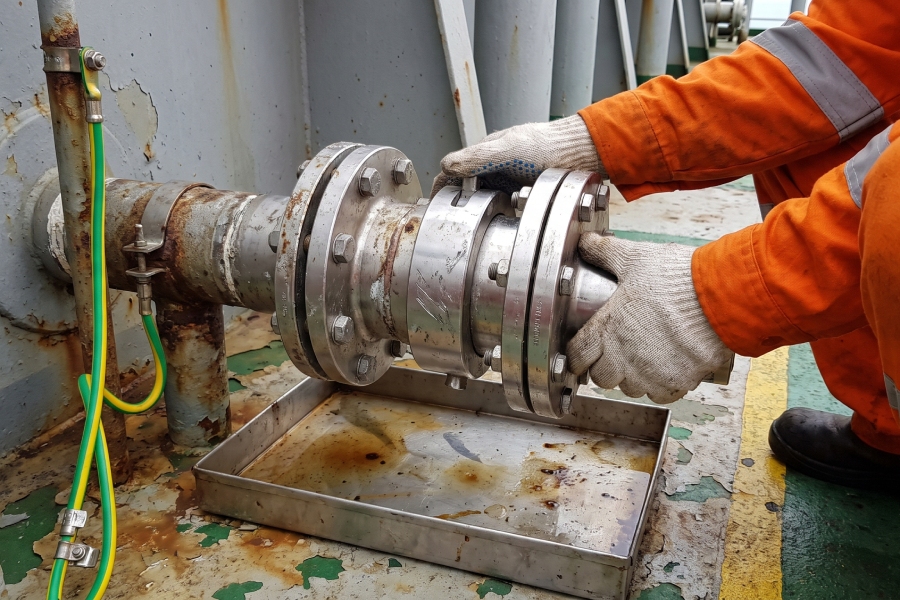
Coupling choice is where spill control is won or lost. ABS describes bunker connections equipped with dry-disconnect couplings with break-away coupling or quick release and self-sealing functions, which is a compact way of saying the joint should close itself both when it is parted deliberately and when it is parted by accident. With a toxic, low-flash liquid, a few litres released at deck level is a very different event from the same volume of fuel oil.
Breakaway devices deserve specific thought about the load case. The coupling has to part at a force below the point at which the hose or the manifold would fail, and that force depends on hose construction, the length of the string and the sea state on the day. Getting the parting load wrong in either direction removes the protection you thought you had, and best practices in liquid cargo handling apply here as fully as they do on a chemical berth.
Static, earthing and vapour
Ignition sources explain why the procedures around methanol look strict. ABS identifies static build-up in the bunker hose and differences in potential between the receiving ship and the supplier’s facility as two causes of arcing, and calls for earthing of the road truck or ISO tank and the ship with a bonding wire.
That has practical consequences for equipment. Bonding continuity has to be verifiable instead of assumed, and any insulating flange or hose section in the string changes the picture. Check the arrangement against both the vessel’s procedure and the supplier’s, because a mismatch between the two is a common finding.
Vapour management follows the same reasoning. Because the vapour is toxic and the lower flammable limit is reached at a modest concentration, vapour return arrangements and gas detection at the manifold belong in the transfer design instead of on an optional extras list.
Testing and recertification
Test intervals tighten for this service. The ABS advisory sets out prototype testing of each hose type at 200 cycles from zero to at least double the maximum working pressure followed by burst testing, hydrostatic testing of in-service hoses at not less than 1.5 times the specified maximum working pressure, and recertification every six months for uniquely identified hoses. Build that six-month cycle into the maintenance plan before the first transfer, with tagging that ties each hose to its own test record.
What to confirm before you specify
Most procurement mistakes in this area come from asking for a part number instead of describing a duty. The useful conversation starts with the medium, the pressure and temperature range, the connection type at each end, the length and support arrangement, and the testing regime the operator expects.
- A written compatibility statement from the manufacturer for methanol at your service temperature.
- Working pressure and test pressure, with the certificate tied to the individual assembly.
- End connection type and gasket material, confirmed against the manifold on both sides.
- Electrical continuity or discontinuity, whichever the bonding arrangement requires.
- Marking and traceability, so any hose can be tied to its certificate and its next test date.
- Handling and storage requirements, since alcohol-service assemblies can be sensitive to contamination.
We supply hoses and hose fittings across rubber, Teflon, stainless steel and silicone constructions, along with dry disconnect couplings and breakaway couplings, and customisation is available where a standard assembly does not suit the arrangement. What we will not do is call a part suitable for methanol without compatibility data behind it, and any supplier who does should be asked for the paperwork.
Treat any lead time or cost indication as exactly that, since both move with specification, material, quantity and current supply conditions.
Conclusion
The port’s fuel mix is changing faster than most equipment registers are. Reviewing the transfer string now, while the number of alternative-fuel calls is still small, is considerably easier than reviewing it after an incident report has been written.
If you are preparing for alternative-fuel transfers and want a second opinion on the assemblies you already hold or the ones you are about to buy, our team at Pharmchem Engineering is glad to work through the duty with you. Send us the details of the operation and we will help you get the specification right.