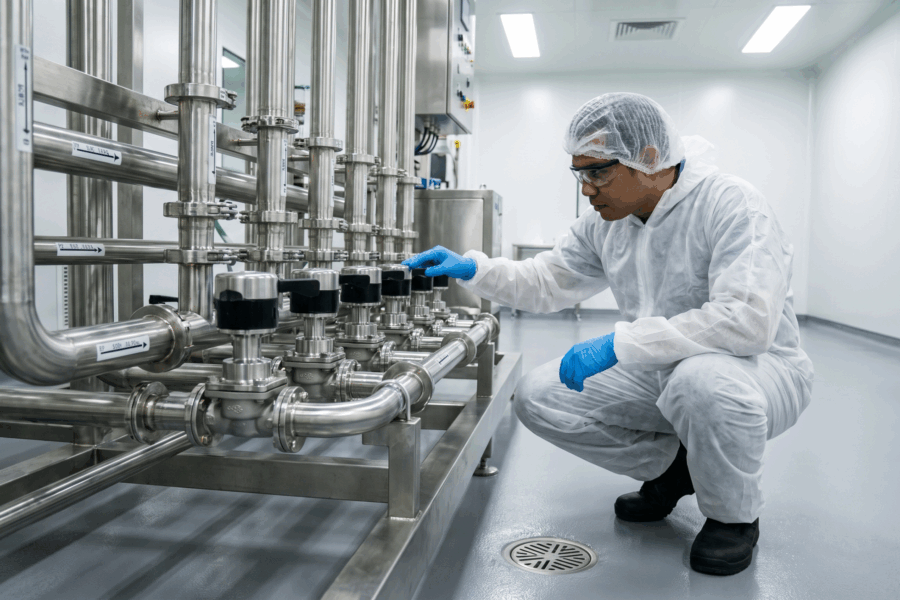
Dead Legs In Hygienic Piping: How To Design Them Out
A clean-in-place cycle runs to completion, every temperature and conductivity set point is met, and the swab taken from one short branch near a sample valve still comes back positive. The system did exactly what it was told to do. The trouble is that a small length of pipe on that branch never saw the flow the rest of the line did.
Dead legs are among the more stubborn hygienic design faults because they are almost always created for sensible reasons. A spare port for a future tie-in, an instrument tee, a sample point, a valve left in place after a process change: each decision made sense on the day, and each can leave a pocket that cleaning solution reaches slowly and drains from badly.
What counts as a dead leg
A dead leg is a length of pipe branching off the main flow path where the fluid is not swept by bulk flow. Product, water or cleaning solution sits there and exchanges with the main stream mainly by diffusion, which is slow, and slow exchange is how a biofilm becomes established. Clean-in-place makes it worse than it first appears, because cleaning depends on flow velocity to generate wall shear as well as on temperature and contact time. A branch with no flow through it loses the first of those entirely, and the temperature at the blind end can sit well below the set point measured on the return line. Component geometry decides much of this, which is why sanitary pipe fittings and valves need choosing for how they drain as much as for how they seal.
Where they come from
Instrument connections are the most common source. A pressure transmitter or temperature sensor mounted on a tee with a length of pipe between the main line and the sensing element creates precisely the geometry to avoid. Inline sensors that sit flush with the pipe wall remove the problem instead of managing it.
Sample and drain points come next. A sample valve on the end of a stub, a drain valve fitted to a horizontal run above the actual low point, or a vent line teed off the top of a vessel all create pockets that will not clear on their own.
Then there is history. Systems accumulate branches over the years: a line that once fed a vessel and is now capped, a bypass installed during a commissioning problem and never removed, a spare port left for a project that never happened. Every plant walkdown finds a few, and taking them out is usually cheaper than validating around them.
The L over d ratio and where it stops helping
Hygienic design guidance expresses branch length as a ratio, written as L over d, where L is measured from the inside wall of the main pipe to the blind end and d is the internal diameter of the branch. The ASME Bioprocessing Equipment standard, which covers materials, design, fabrication, inspection, testing and certification for equipment used in the bioprocessing, pharmaceutical and personal-care industries, addresses branch length through that ratio, and the figure most often quoted as a target is two or less.
Treating the ratio as a pass mark is where teams get caught out. Cleanability at a given ratio also depends on velocity in the main line, on branch orientation, on temperature and on the cleaning chemistry, and ASME commissioned a dedicated branch leg study precisely because one number does not settle the question. Use the ratio to rank your branches by risk, then verify the difficult ones by swabbing or riboflavin coverage testing.
Orientation and drainability
Orientation decides whether a branch drains or holds. A stub pointing downwards from a horizontal line will at least clear by gravity, while the same stub pointing upwards holds liquid indefinitely and traps air during filling, which shields the surface from cleaning solution altogether. Where a branch cannot be eliminated, turning it so that it drains towards the main line, and sloping the main line itself towards a low-point drain, removes most of the residual risk at almost no material cost.
Component choices that design the problem out
Most dead legs disappear through a different fitting choice instead of a pipe re-route. The right components shorten the branch to almost nothing, and the difference in installed cost is small set against a failed validation.
- Zero-static or tank-bottom diaphragm valves, which place the seat directly at the vessel or main line wall.
- Inline instrument fittings that put the sensing element in the flow path instead of on a stub.
- Radial diaphragm valves on branch connections, sitting tight against the main line.
- Short-outlet and pulled tees, which shorten the branch geometrically.
- Aseptic sample valves designed to be flush-mounted and steam-sealed.
Material and finish still apply once the geometry is right. Specifying highly durable sanitary pipe fittings in a grade suited to the product keeps the surface cleanable across the life of the installation. Our sanitary range is supplied in SUS 304, SUS 304L, SUS 316 and SUS 316L, in DIN, IDF and SMS connection styles among others, and is made to 3-A sanitary standards.
Where the geometry genuinely cannot be resolved with a standard part, a fabricated assembly is the honest answer, and custom work is available for exactly that.
The dead legs you cannot remove
Some branches survive every design review, among them relief valve connections, nitrogen blanket lines and sample points required by a regulator. Those need documenting instead of forgetting. Record the ratio, note the orientation, bring them explicitly into the cleaning validation, and set a swab point at each one so the monitoring programme sees them. A known dead leg under surveillance is a manageable risk, while an undocumented one is the reason a batch investigation runs for three weeks.
Conclusion
Hygienic piping rewards attention at the detail level. Branch length, orientation, slope and component choice are settled on a drawing in a single afternoon and then live with the plant for twenty years, which makes the design review the cheapest place to get them right.
If you are working through a hygienic piping layout, replacing components on an existing skid, or trying to close out a cleaning validation finding, our team at Pharmchem Engineering can help you choose parts that suit the duty. Get in touch with your line details and we will take it from there.