Pig Launchers And Receivers: Checks Before Every Run
The barrel door swings open at the receiver, the crew looks inside, and the pig is not there. Somewhere along the line a foam pig has either broken up or lodged against an obstruction, and what began as a routine cleaning run has turned into a locate-and-recover job with the pipeline out of service.
Most pigging problems trace back to the two ends of the operation instead of the pipeline in between. Launcher and receiver stations carry the valves, seals, vents and drains that make a run controllable, and they are where a careless five minutes becomes a shutdown. The same set of checks before every run is the cheapest reliability measure a plant team has.
What the launcher and receiver actually do
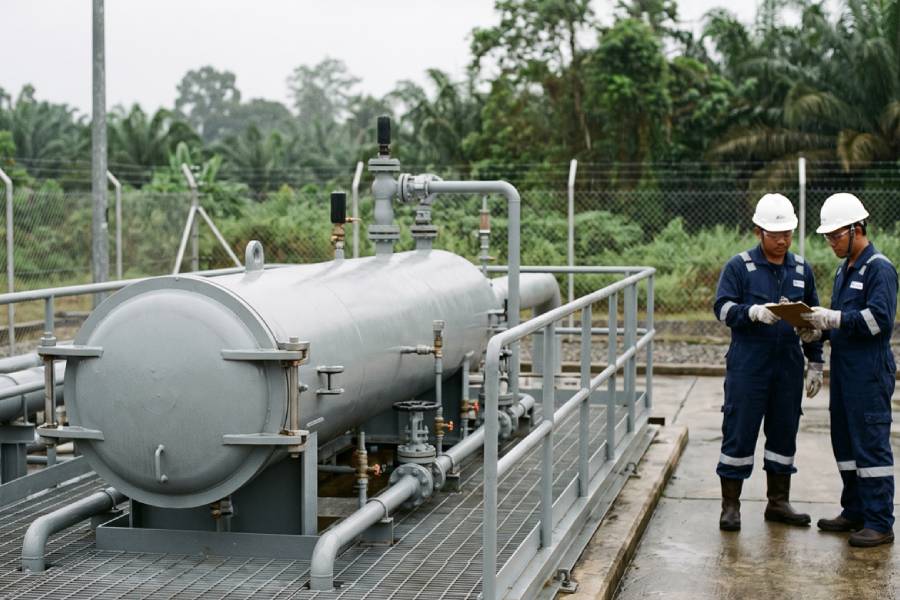
A pig launcher is a pressure-containing barrel, larger in bore than the pipeline itself, connected to the line through a reducer and a kicker line. The pig is loaded in, the closure is secured, the barrel is brought up to line pressure and the kicker line drives the pig into the main flow.
A receiver reverses the arrangement at the far end, catching the pig along with whatever it has pushed ahead of it. The pigs get most of the attention, but the barrels, closures and valves are as much part of the pipe pigging equipment as the pig itself.
Which pig you send changes what the station has to do. Foam pigs deform to negotiate bends and reduced-bore sections, while solid cast pigs hold their shape and scrape harder, so a stiffer pig needs more differential pressure to start moving.
The registration question comes first
Launchers and receivers are pressure vessels, and in Singapore that carries a legal position instead of a design preference. The Ministry of Manpower requires that pressure vessels in workplaces be registered by an Authorised Examiner before they are put into operation, with inspection requirements applying during service and approval needed before any repair. Whether a given barrel falls inside that definition depends on its dimensions and duty, so have the classification confirmed by a competent person before commissioning.
Before the pig goes in
The pre-loading walk-round catches most avoidable failures. The barrel needs to be depressurised and drained, and the closure seal needs to be clean and undamaged before anything is loaded into it.
- Closure seal and seating surface: clean, unscored, with the seal renewed if it has taken a permanent set.
- Barrel interior: no residual debris, scale or product left behind from the previous run.
- Pig condition: correct type and size, with no tears or wear that would shed material in service.
- Valve line-up: kicker, main line and bypass valves as the procedure calls for, verified by a second person.
- Vent and drain routing: to a safe location, with the receiving vessel or drain point confirmed as having capacity.
- Pressure and temperature indication: gauges reading correctly and inside calibration date.
Pig sizing deserves a fresh look every time. A pig sized for a nominal bore behaves differently through a relined section, and one that passed comfortably six months ago can jam once a repair has changed the internal profile.
Where a line carries restrictions, unbarred tees or tight-radius bends, it may not be piggable at all in its present form. The issues that lead to unpiggable pipelines tend to be structural, and no amount of care at the launcher compensates for them.
Pressurising and launching
Bringing the barrel up to pressure is where a written procedure earns its place. The closure must be fully secured and the vent closed before pressurisation begins, and nobody should stand in line with the closure while pressure builds. Pressurising against a closure that has not latched correctly is among the more serious failure modes here, which is why plants insist on a signed permit and an independent check.
Once the barrel is at line pressure, the kicker line is opened gradually so the pig is not driven hard into the reducer. The launch pressure trace tells you whether the pig has actually left the barrel, and a pressure that holds steady instead of dropping away usually means it has not.
Tracking the run
Pig passage indicators at intermediate points give you position and speed, and speed governs cleaning quality. Travel too slowly and the pig stalls in low points; travel too quickly and it skims over deposits without lifting them. Flow rate is the lever, so agree the target velocity with the process side before the run rather than adjusting it halfway through.
At the receiver
The receiver is the dirty end of the job. Everything the pig has moved arrives at once, so the barrel needs the capacity to take it and a drain route sized for both the volume and the nature of the deposit. A receiver that fills faster than it drains starts pushing debris back into the line.
Depressurising and opening a receiver is a controlled operation, with a positive check at the vent before anyone touches the closure. Where the line carried hydrocarbons or anything toxic, the plant’s gas testing and hazardous media procedures apply, and the crew doing the work should be trained and authorised for it.
What the recovered pig tells you
The pig that comes out is a diagnostic sample. Even wear around the circumference suggests a clean run through a consistent bore. Wear concentrated on one side points to a pig travelling without rotating, which often means a long unsupported section or a partial obstruction.
Deposit type is equally informative. Hard scale suggests the interval between runs has stretched too far, while heavy dark debris in a water line points towards corrosion products and a possible internal coating problem.
Keep the records. A station log capturing pig type, launch and receive pressures, run time and recovered condition builds the history you need to justify an interval, and it carries far more weight with a turnaround planner than any single run.
When a standard barrel does not suit the line
Not every pipeline is served by a catalogue arrangement. Odd bore combinations, restricted access, unusual deposit loads, or a line that has to stay in service can point towards a purpose-built barrel, closure or trap, and our customisation service exists for those cases.
Conclusion
A cleaning run is only as controlled as the two stations at either end of it. Consistent checks, honest records, equipment sized for the line, and a crew who know the procedure remove most of the surprises, at far less cost than one unplanned recovery job.
If you are reviewing a launcher or receiver arrangement, or planning a cleaning programme on a line that has not been run for a while, our team at Pharmchem Engineering is happy to talk the duty through with you and help you specify equipment that suits it. Get in touch and tell us about the line.