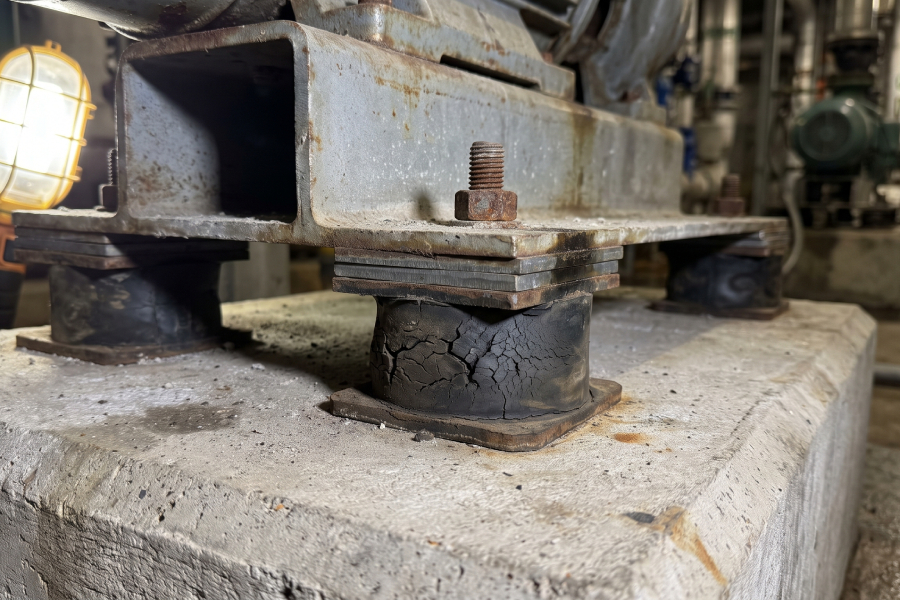
When To Replace Anti Vibration Mounts: Warning Signs
The generator that used to hum now rings through the deckhead, and the plate under the compressor has a hairline crack nobody remembers seeing last year. No fault was logged and no alarm tripped, yet the machine is telling anyone who will listen that the isolation beneath it has stopped doing its job.
Rubber wears out quietly. Unlike a bearing that whines or a seal that drips, an isolation mount degrades over years without a single obvious event, and by the time the symptoms are unmistakable the surrounding structure has usually absorbed some of the damage. Knowing what to look for turns that slow failure into a planned replacement.
Why mounts age even when nothing goes wrong
Elastomers change with time under load. The polymer network relaxes, which shows up as compression set, meaning the mount no longer returns to its original free height once the load is removed. That lost height changes static deflection, and static deflection determines the mount’s natural frequency and therefore how well it isolates anything at all.
Heat accelerates the process, and so do ozone, ultraviolet light, oil contamination and repeated shock loads the mount was never sized for. Anti vibration mounts working in a tropical engine room face high ambient temperature and salt-laden humidity together, which is a harder duty than the same part installed in an air-conditioned plant room.
None of this means a mount has failed the day it changes shape. Elastomer mounts are expected to take an initial set during their first weeks in service, and manufacturers account for it in their load-deflection data. What you are watching for is drift well beyond that settled position.
The signs on a walk-round
Most of what you need is visible with a torch and five minutes, provided the machine has been shut down and isolated before anyone puts a hand near it.
- Cracking or surface crazing in the rubber, particularly along the bond line where rubber meets metal.
- Elastomer bulging or squeezing out at the sides, which suggests the mount is carrying more than its rated load.
- A reduced gap between the machine baseplate and its foundation compared with the commissioning measurement.
- Bond separation, where rubber has begun to lift away from the metal plate or insert.
- Slack, elongated or repeatedly retightened holding-down bolts.
- Oil staining and softening of the rubber, or a chalky surface where ozone attack has taken hold.
What the machine tells you first
Symptoms often appear in the structure before the mount looks bad. Noise breaking out into adjacent spaces, fresh vibration felt through handrails or bulkheads, fretting marks on shim plates, and bolt tension that will not hold are all signs that energy has found a path it did not have before.
Broad-band vibration measurement gives you a defensible number to argue from. ISO 20816-1 sets out general guidelines for the measurement and evaluation of machine vibration, and a trend recorded against that framework is far more useful than a single reading taken on a bad day. Watch for a rising trend at the machine feet, because stopping energy reaching the foundation is precisely what the mount is there to do.
Loaded height is the most useful number you have
If you record one thing at commissioning, record the loaded height of every mount. It takes minutes with a depth gauge or a set of feeler gauges against a straight edge, and it gives you a baseline that nothing else substitutes for.
Manufacturers publish load-deflection curves showing how far a given mount compresses under a given load. A mount sitting noticeably lower than the curve predicts is either overloaded or has taken excessive set, and in both cases its natural frequency has shifted upwards, which erodes isolation efficiency.
There is no universal replacement threshold, since the limit depends on the compound, the geometry and the design deflection. Ask the manufacturer for the figure that applies to the part you have installed, then keep the answer in the maintenance file alongside your commissioning measurement.
Environment sets the clock
A mount under a chilled water pump in a conditioned plant room may run for a decade with very little change. The same part under a deck-mounted fan exposed to sun, rain and salt spray can be finished in a fraction of that time.
Machinery spaces aboard a vessel present the full combination, which is why solutions for vibration control at sea are treated as a design problem in their own right instead of a component choice. Approved models of various marine classification types are available from us on request, though the approval that applies to any particular installation remains a matter for the class society and the specifier.
Setting an interval you can defend
Condition-based replacement beats calendar-based replacement wherever something can be measured, and mounts can be measured. A workable approach is an annual height and visual check on critical machines, a shorter interval on anything exposed to weather or shock loading, and replacement triggered by measured drift instead of age alone. Where unplanned downtime on a machine is unacceptable, replacing at a fixed interval and treating the removed parts as inspection samples is a reasonable trade.
Replace one or replace the set
Fitting a single new mount alongside three that have aged in service leaves the load unevenly shared. The new part is stiffer, so it takes more than its quarter of the weight and the machine sits out of level. Replace the set, and replace like for like unless the selection has been re-run.
Re-running the selection is the right call whenever something has changed: extra equipment added to the baseplate, a different operating speed, a new foundation, or a levelling problem that keeps coming back. Load per mount, centre of gravity, excitation frequency and available height all feed into the choice.
Where the original part is obsolete or the duty has moved beyond a standard item, a custom mount is usually a cleaner answer than shimming a near-fit into position.
Conclusion
Isolation degrades slowly, and slow problems are the ones that get deferred. A commissioning measurement, an annual look, an honest record and a habit of replacing in sets will keep a machine sitting where its designer intended and keep noise and wear out of the structure around it.
If you are seeing more vibration than you used to, or you are unsure what the mounts under a critical machine are actually doing, our team at Pharmchem Engineering can help you work through the load and the duty and find a suitable replacement. Reach out and tell us what the machine is doing.