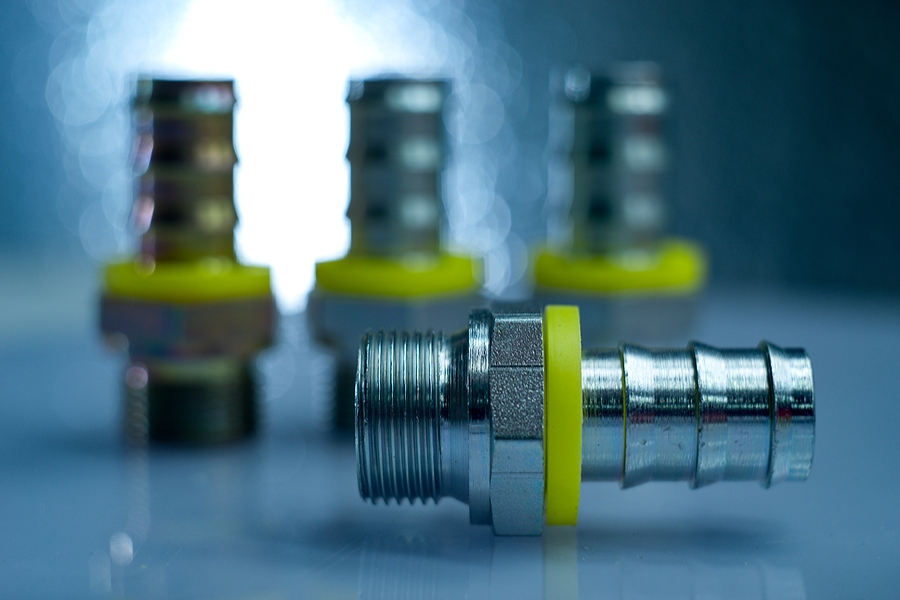
Stainless Steel Hose End Fittings: Flanged, Threaded, Welded
When you are working with industrial hose systems, the fittings at each end of the hose are just as important as the hose itself. Get the fitting type wrong, and you risk leaks, pressure loss, or a connection that simply does not hold up to the demands of your operating environment. The good news is that once you understand the three main types of hose end fittings, making the right choice becomes much more straightforward.
Flanged, threaded, and welded fittings each serve a distinct purpose, and each has a context where it performs best. This guide breaks down how each type works, where it is commonly used, and what to consider when choosing between them, so you can make a confident, informed decision for your system.
Why stainless steel?
Stainless steel offers excellent corrosion resistance, handles high temperatures well, and maintains structural integrity under pressure. These qualities make it suitable for demanding environments such as chemical processing, food and beverage production, marine and offshore operations, and general industrial use.
A stainless steel hose paired with the right end fitting forms a reliable, durable connection that can handle the rigours of daily industrial use. For applications where hygiene, chemical compatibility, or saltwater exposure is a factor, stainless steel is the dependable choice. Stainless steel hoses for Singapore’s marine and offshore work are a prime example of how the material performs across some of the most demanding conditions in the region.
Flanged hose end fittings
Flanged fittings feature a flat, disc-shaped collar at the end of the hose that bolts directly onto a corresponding flange on a pipe, pump, or vessel. The connection is sealed using a gasket compressed between the two flanges.
Best for: high-pressure systems, large-diameter hoses, and applications where the fitting needs to be dismantled and reassembled regularly.
Flanged connections are extremely secure and easy to disconnect when maintenance is required. Because the joint is bolted rather than threaded, it distributes load evenly across the connection point, which reduces stress on the hose and fitting over time.
You will typically find flanged hose end fittings in:
- Industrial pipelines carrying steam, chemicals, or high-pressure fluids
- Marine and offshore systems where connections must withstand vibration and movement
- Water treatment and pumping stations
- Power generation facilities
One thing to note is that flanged fittings require more space and installation effort compared to threaded alternatives. They also need matching flanges on the equipment they connect to. For large-scale, permanent installations where reliability is the priority, flanged fittings are difficult to beat.
Threaded hose end fittings
Threaded fittings connect by screwing directly onto a corresponding threaded port or fitting. They are compact, fast to install, and widely available in a range of thread standards, including BSP (British Standard Pipe) and NPT (National Pipe Thread).
Best for: low-to-medium pressure systems, smaller diameter hoses, and applications where quick connection and disconnection are needed.
Threaded fittings are the go-to choice for many general-purpose applications because they are simple and cost-effective. Installation requires no special tools beyond a spanner, and replacement is straightforward.
Common applications include:
- Hydraulic systems in machinery and equipment
- Pneumatic lines
- Fuel and oil transfer
- General workshop and manufacturing environments
The main consideration with threaded fittings is thread compatibility. Mixing different thread standards is a frequent source of leaks and connection failures, so always confirm the thread type on both the fitting and the port before installation. Thread sealant or PTFE tape is also commonly used to improve the seal and prevent galling on stainless steel threads.
For high-pressure or high-vibration environments, threaded connections may loosen over time and require periodic checking. In these cases, a flanged or welded connection may offer greater long-term reliability.
Welded hose end fittings
Welded fittings are permanently attached to the hose end through a welding process, creating a single, unified connection. There are no threads to strip, no bolts to loosen, and no gaskets to replace.
Best for: high-pressure, high-temperature, and high-purity applications where a permanent, leak-free connection is essential.
Because the fitting is fused to the hose, welded connections offer the highest level of integrity. They are particularly popular in industries where even minor leaks carry serious consequences, such as pharmaceutical manufacturing, semiconductor production, and certain chemical processing environments.
Welded fittings are also common where hygiene is critical. Without crevices or threads that can trap material, they are easier to clean and less likely to harbour contaminants.
The trade-off is permanence. Once welded, the fitting cannot be removed and reattached. If the hose or fitting needs replacing, the entire assembly typically needs to be replaced as well. This makes welded fittings less practical for systems that require frequent maintenance or reconfiguration.
Choosing the right fitting for your application
With three distinct fitting types available, the right choice depends on several factors specific to your system and operating environment.
| Factor | Flanged | Threaded | Welded |
| Pressure rating | High | Low to medium | High |
| Installation ease | Moderate | Easy | Requires welding |
| Maintenance access | Easy to dismantle | Easy to dismantle | Permanent |
| Hygiene requirements | Moderate | Moderate | High |
| Cost | Higher | Lower | Moderate to high |
If your system requires regular maintenance access and operates at high pressure, flanged fittings offer the best combination of security and convenience. For smaller, lower-pressure systems where quick installation is a priority, threaded fittings are the practical choice. For applications that demand a permanent, contamination-free connection, welded fittings provide unmatched reliability.
It is also sensible to consider the overall operating environment. Vibration, thermal cycling, chemical exposure, and the frequency of connection and disconnection all affect how a fitting performs over time.
Conclusion
Selecting the right hose end fitting is not always a straightforward decision, particularly when you are dealing with complex systems or demanding operating conditions. At Pharmchem Engineering, we supply a comprehensive range of industrial hose equipment, including customisable stainless steel hose assemblies to suit your specific requirements.
Whether you need guidance on fitting selection or are looking for a complete hose solution tailored to your application, our team is ready to help. Get in touch with Pharmchem Engineering today to find out how our range of industrial equipment can be configured to meet your needs.